We will also see how I made investment in Bharti Airtel although I was not sure about business and how it will pan out in the future.
First lets start with the markets ,which are rallying like there is no ending.With a PE of 23.07 and earnings showing signs of improvement, although for few companies in nifty , this is quit a handsome proposition(sorry for being sarcastic about the circumstances),but the best opportunities comes under all these uncertainties . Two of which I capitalize on include IL&FS buying Maytas Infra and Bharti beaten up due to price war.I cannot recommend about Bharti but I'm certain about Maytas , yes even at current price levels.Although it's at 161 but it has immense potential , sector is battered , and you should never under estimate the potential of IL&FS management in handling Infra projects . Seriously speaking I was never thinking about Maytas Infra but when IL&FS made a buy offer it came into limelite,prices shot up and prices became very high , but instead of repenting the decision I entered into it. At that time I was still learning the ways how Infra business works (More on it in my next post where I'll try to plug the pieces), what are boo and bot projects, special purpose vehicles etc. and what is the profit proposition in these two.
My second big investment was Bharti Airtel which I'm not sure why I made although I kept myself away from any technology stock since last two years(Sorry to Mr.Buffet).
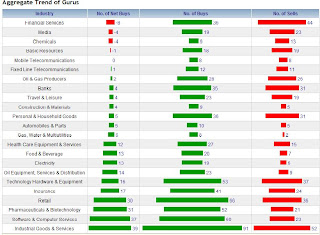
Now let's see about Guru's Investing trend chart.


Well we all are aware of the so many things happening in telecom space. First Bharti lost MTN deal and then Tata Docomo came up with one super cheap scheme and then TRAI trying to make a pay per second a mandatory stuff in every service provider's portfolio. But is there any scope for this price war in already ultra low tariff scenario? If we go with Mr. Mittal then there is no such scope left because according to him the deal should have some economic viability and also it should not be a shocker to the customer. I might not know the nitty-gritties of the telecom sector but I know that telecom has become an essential commodity in our lives and this part cannot be ruled out for decades to come, may be the format of services change but not the need for the service.
If I call this a commoditization of telecom sector then I think I'm not wrong (there may be chances that I'm wrong though). And that's also true that in a commodity type business where profit margins are low then scale play its role. And scale can only be built if SP's can provided better customer support system and also better options for customers.
Our fund had invested on Bharti Airtel in the hey days of October 2008 and it’s constitute 9% of our portfolio. Although it was way beyond Buffet style of investing, but being a technical guy I can understand the difference in the services of different SP's and also the price/value scenario was in our favor at that time. I put that as a bond equity kind of investment where I was suppose to get 25% annual return. My time line if infinite till Airtel is giving me an earning with a coupon of around 5-8% . The whole idea was on the basis that Bharti is still the market leader and it’s like a shark ready to eat others. One good strategy about Airtel is Grow consolidate and then back to the Growth cycle and the spiral continues . Check this out:--
1) Bharti Airtel has 24.3% customer market share and 33.8% revenue market share.
2) Vodafone India has 18.8% customer market share and 20.7% revenue market share.
3) Idea Cellular has 11.2% subscribers market share and 12.1% revenue market share
4) BSNL has subscriber share of 12.7% and mere 10.2% of revenue share
5) Reliance Communications is the worst performer with 18.9% customer market share and pathetic 11.5% revenue market share.
Second, It’s kind of physiological that once you subscribe to a service provider you are least likely to change that until unless service deteriorates which is not with airtel, because my family members and colleagues are satisfied with the hassle free service, although there may be many dissatisfied customers also, satisfaction outnumbers dissatisfaction.
Mr. Sanjay Kapoor President, Mobile Services at Bharti Airtel said,
We will not have a knee jerk reaction. No free minutes models are sustainable. Reliance will eventually withdraw after sometime. Airtel will remain competitive with excellent QoS. Since Reliance GSM launch in the past few weeks, we have not seen any impact nor there is any such caution to be noticed.
And I think he is right , because in the only economic viable model will survive and these short term subscriber oriented schemes will be outdated by better services and support.
Warren Buffet said:-
“If you don’t know jewelry, know the jeweler.”
And I think Mr. Mittal and Mr. Kohli are better jewelers in Telecom space. So I’m not going to sell Airtel that easily!!!!!
Saludos,
Ashutosh
P/E :- 22.90
P/B :- 3.76
Dividen Yield :- 1.00

"You are neither right nor wrong because the crowd disagrees with you. You are right because your data and reasoning are right."
Thanks,
Ashutosh
P/E :- 21.66
P/B :- 3.78
Div Yield :- 1.06


Well this is a real great explanation of Inventory Turn and Profit Marging and I don't want to miss it by any means, that's why I'm adding it in my blog just for educational purpose.
You can visit this article at http://www.fwallstreet.com/blog/189.htm
Understanding the True Profit Margin
By Joe Ponzio on August 7, 2009

On the heels of yesterday's article, I received an e-mail from a friend this afternoon asking me about my thoughts on inventory turns and profit margins. To paraphrase: The math doesn't work right, as the inventory turns don't affect the profit margins each year.
I didn't do a good job of explaining it properly; so, let's look at the "true" profit margin of a company.
The Low Cost Business
We all know that it's better to have a low-cost business than a high-cost business. Companies with relatively small capital expenditures and fat profit margins should be chosen over those with high capital expenditures and thin margins, assuming all other things are equal.
If you can find good companies that generate tons of cash on a relatively small amount of invested capital, and you can buy those companies at a discount to their intrinsic value, you'll probably find that your long-term investment results are quite satisfactory.
Profit Margin on One Inventory Turn
So...we turn to two businesses, each of which has a thin profit margin, to see how inventory turns can give us some insight into the economics of the company. Let's first look at the economics of the business from a single sale perspective to show that they're the same:
(Note: The number of "inventory turns" refers to the number of times a company must replenish its inventory throughout the year. If Walgreens orders one case of Coca-Cola each month, and sells one case each month, it will have "turned" its Coca-Cola inventory twelve times that year.)
| Company A | Company B | |
| Revenue | $ 100 | $ 100 |
| Cost of goods sold | 98 | 98 |
| Other expenses and taxes | — | — |
| Net income / Cash flow | $ 2 | $ 2 |
| Profit margin | 2% | 2% |
In this case, both businesses earned $2 on $100 of revenue. Their profit margins were 2% ($2 divided by $100). Fortunately, they lived in the land of Tina's Family Therapy; so, no taxes or any other costs.
Both companies invested $98 in inventory (cost of goods sold), sold it for $100, and made a $2 profit.Simple enough.
Conventional wisdom would say that both businesses should be avoided. We're supposed to look for businesses with wonderful economics, and a 2% profit margin is anything but "wonderful." Then again, we're all about being non-conventional around here.
Profit Margin on Multiple Inventory Turns
Same companies, but factoring one year of inventory turns into the mix:
| Company A | Company B | |
| Inventory turns | 12 | 2 |
| Revenue | $ 1,200 | $ 200 |
| Cost of goods sold | 1,176 | 196 |
| Other expenses and taxes | — | — |
| Net income / Cash flow | $ 24 | $ 4 |
| Profit margin | 2% | 2% |
Right off the bat, these companies may still look similar. Though Company A has greater sales and revenues than Company B, they both boast 2% profit margins and seemingly terrible economics.
Then again, these are businesses, not just numbers on a piece of paper. And the business of Company A is far superior to that of Company B from an owner's perspective.
What Each Business Invested to Earn Their Income
Let's first look at Company B. To generate $4 in income, it invested $196 in inventory (cost of goods sold), right? Wrong. Because it had two inventory turns, it invested $98 in inventory to generate $100 in sales, took the profit from that, reinvested the $98 in more inventory, and then turned another sale.
Essentially, Company B invested the same $98 twice to earn $4. Already see where this is going?
Company A invested $98 in inventory to earn $2, but was able to reinvest that $98 eleven more times to generate a total of $24.
Both companies invested $98 to earn $2, but Company A was able to reinvest it faster, thus generating six times more than Company B.
The "true" profit margin of Company A was not 2%, but 24%. The "true" profit margin of Company B was not 2%, but 4%. Here's how it works:
True Profit Margins...as Bonds
Think of the true profit margin as a bond with a fixed interest rate. Would you rather have a bond paying 24% or a bond paying 4%? The answer is clear.
Company A and Company B both invested $98 into their business through the purchase of inventory. In essence, each purchased a $98 bond (the inventory), and that bond generates a certain amount of profit ($2). Except that Company A's "bond" pays that $2 monthly while Company B's "bond" pays $2 every six months.
Which company has better economics? They both have terrible profit margins from an accounting standpoint, but then again — accounting numbers are for the IRS. Business owners and investors follow the cash.
Which Company Will Grow Faster?
It's pretty clear in the above example that Company A will have a better chance to grow faster than Company B. It generates more in sales, and it generates more cash. Let's level the playing field. Instead of selling products for $100, Company B is selling higher priced goods. It buys products for $588 and sells them for $600. Both companies have the same revenues, cost of goods, net income, and profit margins:
| Company A | Company B | |
| Inventory turns | 12 | 2 |
| Revenue | $ 1,200 | $ 1,200 |
| Cost of goods sold | 1,176 | 1,176 |
| Other expenses and taxes | — | — |
| Net income / Cash flow | $ 24 | $ 24 |
| Profit margin | 2% | 2% |
So...which is the better investment?
Though it looks like we've leveled the playing field, we really haven't. These are two very different businesses. To understand this, we have to work backwards.
How will Company A and Company B generate additional cash? With no other expenses, they each have three choices:
- raise the price of their products (e.g., from $100 to $105, from $600 to $630),
- lower their cost of inventory (e.g., find cheaper inventory at, say, $90 and $500), or
- sell more of their products.
If they can't raise prices and they can't find any cheaper suppliers, their only option is to sell more of their product. While that is great in theory, it ain't so simple in the real world. Unless they have some magic formula for making cash appear out of thin air, how will they purchase additional inventory so that they can sell more of their finished product?
Assuming neither has cash in the bank or access to outside financing, they have one of two choices:
- require payment upfront, and then use the customer's money to purchase inventory, or
- save up enough cash to purchase more inventory, using the funds of the business.
Some businesses can do the former; but, let's assume that these two companies are retailers, and that their customers aren't paying for clothes today, but willing to take delivery in sixty days. To get more inventory which will lead to more sales, the company's must use the funds of the business.
But wait — neither company has cash in the bank! Okay — how long will it take before the companies can expand? That is...which company will grow faster?
| Company A | Company B | |
| Profits | $ 24 | $ 24 |
| Cost to purchase more inventory | $ 98 | $588 |
| Years until company can handle double sales volume | 4.1 | 24.5 |
In 4.1 years, Company A will have saved $98 from its $24 of profits — enough to purchase another unit of inventory. With two units of inventory both being sold concurrently, the company is generating twice as much cash.
It will take Company B 24.5 years to save up $588, if saving just $24 per year. As such, Company B will have to wait 24.5 years before it can double its cash flow.
Again — which company has the better economics: the one that can double every four years or the one that doubles every 25?
The Race is Over Before it Begins
If we fast forward and look at these two companies in 25 years, assuming that each tried to beef up their inventory at the end of the year (not 0.1 years into year 4), Company B has finally purchased another unit of inventory and will begin generating $48 a year in excess cash. Company A, on the other hand, has 465 units of inventory and is generating $11,160 in excess cash.
And while Company B has finally beefed up sales to $2,400 ($600 times 2 inventory turns times 2 units of inventory), Company A is generating $558,000 in sales — 233 times the amount of sales!
High Profit Margin/Low Turnover
Finally, consider this: A high profit margin business may have a very low "true" profit margin, and may be a candidate to avoid. When comparing a 2% profit margin business to a 10% profit margin business, many investors automatically assume that the 10% business is better.
That's not necessarily true.
Everything else being equal, the 10% margin business with one inventory turn is no better or worse than the 2% margin business with five turns a year.

4 minutes later:
the violinist received his first dollar: a woman threw the money in the hat and, without stopping, continued to walk...
6 minutes:
A young man leaned against the wall to listen to him, then looked at his watch and started to walk again.
10 minutes:
A 3-year old boy stopped but his mother tugged him along hurriedly. The kid stopped to look at the violinist again, but the mother pushed hard and the child continued to walk, turning his head all the time. This action was repeated by several other children. Every parent, without exception, forced their children to move on quickly.
45 minutes:
The musician played continuously. Only 6 people stopped and listened for a short while. About 20 gave money but continued to walk at their normal pace. The man collected a total of $32.
1 hour:
He finished playing and silence took over. No one noticed. No one applauded, nor was there any recognition.
No one knew this, but the violinist was Joshua Bell, one of the greatest musicians in the world. He played one of the most intricate pieces ever written, with a violin worth $3.5 million dollars. Two days before Joshua Bell sold out a theater in Boston where the seats averaged $100.
This is a true story. Joshua Bell playing incognito in the metro station was organized by the Washington Post as part of a social experiment about perception, taste and people's priorities. The questions raised: in a common place environment at an inappropriate hour, do we perceive beauty? Do we stop to appreciate it? Do we recognize talent in an unexpected context?
One possible conclusion reached from this experiment could be this: If we do not have a moment to stop and listen to one of the best musicians in the world, playing some of the finest music ever written, with one of the most beautiful instruments ever made.... How many other things are we missing?
So after a long time, I’m here to write again. So what should I write about? After reading about so many market predictions and how to? recommendations I found myself confounded. Some say buy this sell that , other say “Still no signs of green shoots”. Me as a really small retail investor is apprehensive about every step because my mind is anchored to those hey days of market downfall. Those were the days where you can really throw a dart and come out winning. But things have changed right now and investor need to be cautious and alert as to when to strike the next opportunity.
Well the major issue today almost everyone is facing is an anchoring effect where you get anchored to the 52 weeks high lows and forgot about the real value of the underlining assets (tangible and intangible). Well this is one mistake that I made where I anchored and due to which I was caught by Decision Paralysis, and I lost so many great opportunities. I kept waiting for lows and bottoms but never made a decision. And those actions or inactions cost me making big scores.And I’m going to keep this in mind for future. I’ll keep working on my mental models till they reach from my mouth to my mind. For all the small investors like me , show is not over and you can still fight hard to search for those birds in the bush which are ready to fly and can give good returns according to your bench mark. My Bench Mark is 24% CAGR, which I failed to achieve since I started my fund although I have beaten the market in both the years[Oh no!!! again Anchoring but I have to].
Book Reco:----
I recently completed Mary Buffet’s “Buffet logy” and I’m quite impressed with her simplicity. She has explained the crux of Buffet Investing in a real simple manner to us. I would recommend that Book to You.
Read This article From Sanjay Bakshi’s blog
http://www.sanjaybakshi.net/Sanjay_Bakshi/Blog/Entries/2009/8/2_The_Chart_that_worries_me.html

With the approach of investing in simple businesses,which I can understand I started investing in Page Industries (yes the makers of Jockey brand in india) not a very well known name then what is your idea worth if it's known to everyone.Although stock was not doing great and was keeping low in volumes, the spark came when outlook profit gave an analysis about the company and it's stock soared. Page Industries constitute around 9% of my portfolio although the plan was to make it up to 15-20% , but sudden rise in prices took it out of my buying range.I'm not sure if I'm going to regret later , but I can't risk my and my family's money at this price.With great brand and changing mindset of the Indian Consumer ,while choosing under garment ,this is a sure shot winner.It has high ROE and ROTC and is maintaining good profit margins with good earning growth of around 33% CA.
Visit www.jockeyindia.com and find yourself some boxers or undergarments.
Thanks
Joe Koster's summary of Charlie Munger's Investing Principles Checklist, according to Poor Charlie's Almanack. Charlie’s most basic guiding principles, his fundamental philosophy of life: Preparation. Discipline. Patience. Decisiveness.
Risk - All investment evaluations should begin by measuring risk, especially reputational
- Incorporate an appropriate margin of safety
- Avoid dealing with people of questionable character
- Insist upon proper compensation for risk assumed
- Always beware of inflation and interest rate exposures
- Avoid big mistakes; shun permanent capital loss
Independence - "Only in fairy tales are emperors told they are naked"
- Objectivity and rationality require independence of thought
- Remember that just because other people agree or disagree with you doesn’t make you right or wrong - the only thing that matters is the correctness of your analysis and judgment
- Mimicking the herd invites regression to the mean (merely average performance)
Preparation - "The only way to win is to work, work, work, work, and hope to have a few insights"
- Develop into a lifelong self-learner through voracious reading; cultivate curiosity and strive to become a little wiser every day
- More important than the will to win is the will to prepare
- Develop fluency in mental models from the major academic disciplines
- If you want to get smart, the question you have to keep asking is "why, why, why?"
Intellectual humility - Acknowledging what you don’t know is the dawning of wisdom
- Stay within a well-defined circle of competence
- Identify and reconcile disconfirming evidence
- Resist the craving for false precision, false certainties, etc.
- Above all, never fool yourself, and remember that you are the easiest person to fool
"Understanding both the power of compound interest and the difficulty of getting it is the heart and soul of understanding a lot of things."
Analytic rigor - Use of the scientific method and effective checklists minimizes errors and omissions
- Determine value apart from price; progress apart from activity; wealth apart from size
- It is better to remember the obvious than to grasp the esoteric
- Be a business analyst, not a market, macroeconomic, or security analyst
- Consider totality of risk and effect; look always at potential second order and higher level impacts
- Think forwards and backwards - Invert, always invert
Allocation - Proper allocation of capital is an investor’s number one job
- Remember that highest and best use is always measured by the next best use (opportunity cost)
- Good ideas are rare - when the odds are greatly in your favor, bet (allocate) heavily
- Don’t "fall in love" with an investment - be situation-dependent and opportunity-driven
Patience - Resist the natural human bias to act
- "Compound interest is the eighth wonder of the world" (Einstein); never interrupt it unnecessarily
- Avoid unnecessary transactional taxes and frictional costs; never take action for its own sake
- Be alert for the arrival of luck
- Enjoy the process along with the proceeds, because the process is where you live
Decisiveness - When proper circumstances present themselves, act with decisiveness and conviction
- Be fearful when others are greedy, and greedy when others are fearful
- Opportunity doesn’t come often, so seize it when it comes
- Opportunity meeting the prepared mind; that’s the game
Change - Live with change and accept unremovable complexity
- Recognize and adapt to the true nature of the world around you; don’t expect it to adapt to you
- Continually challenge and willingly amend your "best-loved ideas"
- Recognize reality even when you don’t like it - especially when you don’t like it
Focus - Keep things simple and remember what you set out to do
- Remember that reputation and integrity are your most valuable assets - and can be lost in a heartbeat
- Guard against the effects of hubris (arrogance) and boredom
- Don’t overlook the obvious by drowning in minutiae (the small details)
- Be careful to exclude unneeded information or slop: "A small leak can sink a great ship"
- Face your big troubles; don’t sweep them under the rug
In the end, it comes down to Charlie’s most basic guiding principles, his fundamental philosophy of life:Preparation. Discipline. Patience. Decisiveness.
Groups
The scrips traded on BSE have been classified into various groups.
BSE has, for the guidance and benefit of the investors, classified the scrips in the Equity Segment into 'A', ‘B’,'T', ‘S', ‘TS' and 'Z' groups on certain qualitative and quantitative parameters.
The "F" Group represents the Fixed Income Securities.
The "T" Group represents scrips which are settled on a trade-to-trade basis as a surveillance measure.
The "S" Group represents scrips forming part of the "BSE-Indonext" segment.
The "TS" Group consists of scrips in the "BSE-Indonext" segment, which are settled on a trade-to- trade basis as a surveillance measure.
Trading in Government Securities by the retail investors is done under the "G" group.
The 'Z' group was introduced by BSE in July 1999 and includes companies which have failed to comply with its listing requirements and/or have failed to resolve investor complaints and/or have not made the required arrangements with both the depositories, viz., Central Depository Services (I) Ltd. (CDSL) and National Securities Depository Ltd. (NSDL) for dematerialization of their securities.
BSE also provides a facility to the market participants for on-line trading of odd-lot securities in physical form in 'A', 'B', 'T', 'S', 'TS' and 'Z' groups and in rights renunciations in all groups of scrips in the Equity Segment.
With effect from December 31, 2001, trading in all securities listed in the Equity segment takes place in one market segment, viz., Compulsory Rolling Settlement Segment (CRS).
The scrips of companies which are in demat can be traded in market lot of 1. However, the securities of companies which are still in the physical form are traded in the market lot of generally either 50 or 100. Investors having quantities of securities less than the market lot are required to sell them as "Odd Lots". This facility offers an exit route to investors to dispose of their odd lots of securities, and also provides them an opportunity to consolidate their securities into market lots.
This facility of selling physical shares in compulsory demat scrips is called an Exit Route Scheme. This facility can also be used by small investors for selling up to 500 shares in physical form in respect of scrips of companies where trades are required to be compulsorily settled by all investors in demat mode.
I came across this very unpopular book "Why smart people make big money mistakes and how to correct them" by Gary Belsky and Thomas Gilovich, so I thought that I should try to concise the book so please bear with me...
Here are the principles:---
1)Mental Accounting - is a term used to describe the way people tend to treat money differently depending on where it comes from,where it's kept or how it's spent. It can be useful habit when it leads you to treat savings for college or retirement as scared. But it can be dangerous when it cause you to spend money from some sources- such as gift,bonuses or tax refunds - more quickly than your might otherwise.Think about it and you will realize that you are caught with this bias.
2)Loss Aversion - One of the central tenet of prospect theory - a bedrock principle of behavioral finance - is that people are loss averse . The pain people feel from loosing Rs1000 is much greater than the pleasure they experience from gaining the same amount. this helps to explain why people behave inconsistently when taking risk.. For example the same person can act conservatively when protecting gains ( by selling successful investments to guarantee the profits.) but recklessly when seeking to avoid losses(By holding on to losing investments in the hope that they will become profitable).
3)The sunk cost fallacy - one of the most common behavioral finance mistakes, results in financial decisions that are based on previous investments or expenditures. Such a tendency is harmful for the simple reason that past mistake shouldn't lead you to make future ones.The past is past and what matters is what is likely to happen from now on .Well this is one of the tendency why so many government projects fail in the first place or took too much time for completion.Because once started they can never be closed because so much money has already been spent.
4)Number Numbness: This is the one which haunt most of the people and is again very dangerous . I have been a victim of it before I read something about it in Prof. Bakshi's blog. People give too much importance to big numbers an too little importance to smaller one. This is one of the reason value stores are still lagging behind kirana stores, though the saving potential in value store is more than general corner kirana store.People never thought that these small costs are the main criminals in there financial planning.Bigness bias is another term for this.This can also lead you to pay more than you need to, for the brokerage commission and mutual fund expenses.One common example is, many between us think that investing in a small mutual fund will lead you to greater returns but this is not at all true. Below is an example of sundram Tax saver recently noted No.1 tax saver fund and SBI Magnum Tax gain , both growth. Now both these funds have beaten the sensex since long(SBI Magnum has beaten it since 1996) but SBI magnum has also beaten sundaram since the start of sundaram I don't know why but high expense ratio is a surety.

5) Anchoring: The tendency to weigh certain facts , figures , and events too heavily and make your decision based on those. Example , you came to know that your friend has bought an antic for rs10000 then you will linger to that figure to buy one for you although it's not worth it. You can replace antic with anything : a fine buffet, buying a house, or anything.You just linger to the figure your friend has quoted and would always like to strike a better deal . After all you want to realize everyone your rationality.
6) Decision Paralysis : - Simple! most people never came to decision and keep on fighting with themselves to prove the points wrong. They seek lot of information , do thorough research and but are still skeptical about making a decision to buy any investment, buying a house etc.
Well these are some of the thoughts, Behavioral finance is a vast subject , once you overcame some of the biases, you will realize that you will get an edge towards so many psychological forces which are trying to beat you.
There is one more great book on Psychology :-- "Psychology Of Persuasion" By Robert Cladini,a great reads to.
Thanks,
Ashutosh
"Reading great books is a better concentration technique than doing Yoga :-)"
Although there are considerably more than 800 publicly traded U.S. banks, many investors shy away from this sector. The reported financial statements look funny, and the results don't neatly fit into the handy-dandy screens and formulae that many investors like to use. That's a shame, because as Warren Buffett has shown in the past, well-chosen bank stocks can be as lucrative as industrial, health-care, or technology stocks.
For this column, I am grouping institutions of all stripes -- be they money-center banks like Citigroup (NYSE: C), regional banks like BB&T (NYSE: BBT), or savings and loans like Washington Mutual (NYSE: WM), under the generic title of "bank." While there are differences among the types, that's a topic for another day.
The basics
Let's start off with a brief examination of what banks do. Simply put, banks buy and sell money. Banks purchase money through deposits like checking and savings accounts; CDs; and debt or equity financing, or both. Banks sell money by making loans or investing in securities, or both. Buy low and sell high -- value creation at its finest.
Most, if not all, banks also make money from a constellation of fees and service charges. Some will even sell off almost all of their loans shortly after origination. Furthermore, many banks also have other income-producing operations, like asset-management and insurance businesses.
Interest rates are important to banks because they essentially determine the price at which money is bought and sold. But it's not particularly Foolish to make sweeping statements like "rising/falling rates are bad." Good bank managers are neither stupid nor helpless, and they can adjust to different environments.
To a large extent, then, the more important factor is how interest rates behave relative to a bank's management's expectations. If managers are preparing for higher rates, and those higher rates don't materialize, it's likely that the business won't perform as well as hoped (and vice versa with falling rates). Unfortunately, there really isn't a handy ratio or formula to easily establish management's expectations. It requires paying attention to Securities and Exchange Commission filings like 10-Ks and 10-Qs and management comments during conference calls.
Growth
There are many moving parts to a bank. It doesn't really have revenue in the normal sense of the word, but you can look at the combination of interest income (minus loss provisions) and non-interestincome as a proxy. Clearly, you'd like to see these numbers going up.
Deposit growth and loan growth are also both important. If deposit growth is weak, other more expensive sources of funds might have to be tapped. Likewise, if loan growth is sluggish, it will be more difficult for the bank to earn a profitable spread on the money it controls.
Let's also not overlook earnings growth -- a growing bottom line is just as important to a bank as any other company. So, for all of the fancy or confusing concepts that follow, don't forget that income and per-share earnings growth are still important.
Profitability
As is the case with any business, profitability is paramount to banking success. Strong profitability can easily spell the difference between an average stock and an above-average winner.
Net interest margin is a good baseline measurement of the profitability of a bank's core lending and borrowing business. Net interest margin is basically the difference between interest income (loans, securities, et. al.) and interest expense (deposits, borrowed funds, et. al.). In some ways, I suppose you could think of it as a bank's gross margin.
When analyzing net interest margin, I'd suggest you do so in the context of similar banks and their strategies. Among banks in similar lines of business, higher margins can be a sign of great management. But it could the result of riskier lending policies. Narrower margins can suggest trouble on the deposit side and a higher cost of funds. Or it could mean more conservative lending practices. Context matters when comparing numbers.
The efficiency ratio is another useful metric. There are different ways to calculate this number, but the fundamental underpinning is the same: It is designed to measure the ratio of non-interest expense to income. Ideally, you want this number to be as small as possible -- the smaller the number, the less being spent on things like marketing, salaries, and branch expenses, and the better the earnings.
Assets
A bank's capital structure, asset quality, and liquidity are all important. Because the spreads on borrowing and lending money are relatively narrow, banks employ considerable leverage to pump up their earnings power. To make sure that banks don't overdo it and imperil their solvency, bank regulators impose limits.
To be "well capitalized," a bank must have a ratio, expressed as a percentage, of risk-based total capitalto total assets of 10%. ("Risk-based" refers to certain adjustments that are made to reflect that some assets -- like cash and treasury securities -- are less risky than others.) Likewise, shareholders can examine the ratio of shareholders' equity to assets to get a grasp on whether the company is increasing or decreasing its leverage.
Asset quality is important; if people don't repay their loans, the bank in question will have some problems. Numbers to look out for include net charge-offs, the percentage ofallowance of loan losses to total loans, and the percentage of non-performing loans tototal loans. Watch their trends to see whether asset quality is going downhill.
Liquidity is also important in the banking world; it basically reflects how easily a bank can lend money. If a bank is very liquid and has a lot of cash on hand, it can respond very quickly to new opportunities. Of course, there is an opportunity cost associated with keeping cash on hand -- you may lose out on what you could make by lending it out. So if a bank is too liquid, it's leaving money on the table. There are two quick ways to check liquidity -- the percentage of assets held in cash and treasury securities and the loan/deposit ratio. Ideally, this latter number should be near 100% for most well-capitalized banks.
Performance
All other things being equal, it's generally a good idea to invest with the folks who've proved that they can make the most money with a given amount of capital. One way to make that judgment is to look at a company's return on assets and return on equity. In a sense, these metrics capture the end result of a management's decisions on liquidity, leverage, credit quality, and other operational options.
The one note of caution I'd sound on return on assets is that you should make sure you're comparing banks with similar business models. Banks that generate a lot of non-interest income, like Bank of New York (NYSE: BK), can sometimes require less assets on a dollar-for-dollar basis than more lending-focused banks. So comparing across these lines can give you misleading results.
Return on equity is also highly useful for me. I like that you can break it down into net margin, asset turnover, and financial leverage and study how and why one bank may be better than another. Moreover, I've found that banks where management has consistently produced above-average return on equity are often above-average performers in the stock market.
Know the business
There is no such creature as a "typical bank" -- each has its own nuances and individual risk factors. Take beleaguered DoralFinancial (NYSE: DRL), for instance: While it looked good by the numbers and had a heck of a run, there was a ticking time bomb in the way the company valued aspects of its mortgage operations. Had you simply relied on the numbers and not dug into the 10-K, you could have easily been fooled into thinking the bank was safer than it really was.
Knowing the business is also important when you compare banks. Comparing a huge money-center bank like KeyCorp (NYSE: KEY) with a regional bank like Bank of theOzarks (Nasdaq: OZRK) just doesn't make sense. So the more you know about the business, the more likely you are to understand what the numbers are really telling you.
Don't overthink this
We have offered this brief treatment on bank stock analysis to help you with your evaluations of these stocks. But as is always the case, numbers tell only a certain side of the story. It's important to do your own due diligence and strive to really understand the policies, strategies, and expectations of the company in question before buying a small piece of it.
True, the banking sector has some unusual ratios and metrics for measuring performance, but don't get bogged down in the details. Ultimately, the pattern of success behind a bank stock investment is little different than that for most any other company -- a pattern of consistent growth in earnings, dividends, and assets, skillful and honest leadership, and expectations of further growth.
United Spirits Ltd:--
Equity -2009.32 cr
debt :- 1162.08 cr
at 12.5 or more expensive 13% interest rate 152 cr interest annually which is fully supported by the 5 year average PBDIT of the company. So it is well withing it's debt capacity.
Same is the case with United Spirit Breweries so no problem.
Now coming to KF airlines:---
Now let Mr.Mallya keep saying that losses has been reduced to rs 5 cr. Even if we don't give any heed to this let see what is in the hands of lenders and shareholders infect I don't care about KF airlines shareholders because they have put there money in a bad business, But still for United Spirit let's see how it's lenders' money is secured by the assets alone.(I don't know if lending has been completed or is in the talks but still see to the figures):----
KF airlines:--
Equity 192.87 cr
Debt 934.38
Final figures:--
equity 192.87cr
debt 1934cr (After rasing debt)
This debt has to covered by assets for lenders to restict themselves from exercising pledged shares.
Now the fleet of KF airlines include A319/A320/A321, ATR etc and around 71 in service flights.
Lowest Model ATR costs around 12-16mn but I'm considering only 10mn USD. it has a fleet of 27 ATR so the value is Rs 1188Cr.
Lowest model Airbus it has A319 costs around 44mn USD so it has a fleet of around Rs 7700Cr.
Moreover it can make money in trading in aircraft delievery slot. Search internet to get what it really means.
so Infect it is covered well by it's assets even if you take 50% margine of safety. And I don't think any lender will exercise the shares even when it's sure to get it's entire money,from asset sell.
I find no reason that investors should dump this stock. Well let some do but let the others more considerate ones, be aware of the facts and then take decision. These conditions are very rare and investors should take full advantage of this. I don't see any problem with US Business but I do am concern about there airline business which as always been a wealth eroding business but if Mallya can do a turnaround of KF airlines I'm sure this will be a good sign for KF Shareholders.Till then happy investing.
Now let us move to an even more interesting theme which I like to call the debt capacity bargains and I find it very interesting because it has got an academic angle to it. And the academic angle is this:
The value of a debt free company has to be substantially more than the amount of debt it can comfortably service. It's a principle which was first laid out by Ben Graham in Security Analysis and he wrote about it again and again in successive editions and he produced examples in the annexure that this is a company, this is the valuations in the market, this is the amount of debt that it can comfortably finance, it is a debt free company -- why are the stockholders of this company valuing in this company at such a low price?
I'd like to give an example of a person who is in financial trouble and he goes to a pawnshop and tries to take a loan against his watch. The owner of the pawnshop when he gives out the loan against the security of the watch, wants to make sure that the money he lends is a lot less than the value of the watch. And that's exactly what happens when you go to any lender. If you are a good lender, then -- and if you are lending money to a business, then you want to make sure that the business to whom you are a lending money is worth a lot more than the amount of money that you want to lend to that business. But the stock market doesn't always think like that. Let me give you some examples.
Here is an unleveraged company A. It's got no debt. It's an all equity finance company. And it has 5 years average profit before interest and taxes of say Rs. 100 crores per annum.
Let us say that A raises Rs. 250 crores by issuing 10 percent bonds and distributes the funds to its shareholders as dividend, which means we are recapitalizing the firm. You are borrowing money and giving it out as dividend. So the total capital in the company remains the same, it's just that the debt-equity ratio changes. Debt was zero, now it is there. Equity goes down, debt has gone up. Total assets remain unchanged.
Now come to think of it, this company which was a PBIT of Rs. 100 crores is issuing bonds for only Rs. 250 crores of 10 percent interest, which means the annual interest will be only Rs. 25 crores, which means the interest cover is -- if you look at it from the perspective of the income statement -- four times, which means it is very safe from a bondholder’s viewpoint. This means the bond fund managers will be pretty happy to give that kind of money to this company against the security of its cash flow and assets. So that's the kind of money this company can easily finance from its cash flow.
From where do the bond holders of this company derive their safety? Their safety comes from the same PBIT number of Rs. 100 crores. Because if this number collapses their bonds are in jeopardy. If this number remains big, the bonds are going to be serviced without a problem. So the bonds are going to enjoy a high credit rating because the interest cover is 4. And these bonds will have a market value of about 250 crores.
Then, what this principle that I have mentioned in the previous slide states is as follows:
The fair value of A before recap cannot be less than the amount of debt it can comfortably service.
It's a very simple mathematical principle which often breaks down in the stock market, providing very interesting opportunities which I will explain in a moment, but just think about it -- you will have to agree with this, that unleveraged company A's market cap cannot be less than this debt part of the leveraged company A, because both these companies are essentially the same companies. The total capital in the companies is the same. Debt is there in company A recapitalized, it was not there in pre-recapitalized unleveraged company A. That's the only difference.
So all that this principle says that it is mathematical impossible for an unleveraged company A to be less than the amount of debt that it can comfortably finance. And in this case we have done the calculation. It is coming to about to Rs. 250 crores.
Then, supposing this unleveraged company A is less than Rs. 250 crores. Now you are going to ask yourself a question, why is it less than Rs. 250 crores?
Because any bond investor, a rational bond investor - a bond fund manager, for example, will gladly subscribe to Rs. 250 crores bond issue of this company against security of only a part of its assets.
If the bond market will value only a part of this company for Rs. 250 crores, then the value of the entire company must be a lot more than Rs. 250 crores, because of the principles of prudent lending requires that kind of lending practices.
If the stock market continues to put a low value on this unleveraged company A, then its board of directors can magically create these own bonds by writing out these bonds and distribute them to the stock holders which they can then sell for Rs 250 cr., and still leave them with their equity ownership intact. Can they not?
Leverage can play an important role in aligning the interest of the stockholders with that of the management, but that's beside the point. I am not arguing about that right now. I ignored the tax factors and all those other things, what I am saying here is that you can't say that this unleveraged company A will be less than the amount of the bonds that the bond investment community will buy without hesitation of the same company. Let me explain. I will give you more examples in a moment.
This concept of distribution was actually given by Graham in his book, Security Analysis, first edition. He gave an example of a company called American Laundering Machinery and I think you should all go and read that example -- if they have this book over here -- it will be very interesting to see what he had to say. And he said that it's ridiculous to think that the bond market is willing to buy bonds of this company and give it Rs. 250 crores and the stock market values this whole company for less than Rs. 250 crores, which has no debt in it. And if that's the case then the solution of the problem has to be that the board of directors create these bonds on a piece of paper and distribute them to the stockholders in proportion to the shares they hold, in effect doing a leveraged recap, delivering to the stockholders of piece of paper that has a market value of Rs. 250 crores and they still have got the original shares with them which is also have a value. So you force the market to correct its mistake.
And I think some of the things that have happened in the U.S. are going to happen in India pretty soon, because I think a company should act when they find their stocks are battered or valued too low. And some of them might be doing that. I don't think that was the logic for the bonus debentures issued by Hindustan Lever, but I think that might have been the logic recently for Marico. If you read the report two days back they are planning to have a meeting where they will consider distributing bonus preference shares to their stockholders. And there have been others. Some years back if you remember NALCO did something like that. They converted half their equity share capital into bonds and distributed them to the stockholders. So this leveraged recapitalization could be a very useful way for companies to ensure that the stock markets don't undervalue them. This particularly applies to a debt free company because they can borrow money and distribute to stockholders and deliver them a value sometimes more than the market cap prevailing before the leveraged recap.
Here is a quote from Ben Graham's Intelligent Investor which describes what I have just explained:
"There are instances where an equity share may be considered sound because it enjoys a margin of safety as large as that of a good bond. This will occur, for example, when a company has outstanding only equity shares that under depression conditions are selling for less than the amount of the bonds that could safely be issued against its property and earning power. In such instances the investor can obtain the margin of safety associated with a bond with all the chances of large income and principal appreciation inherent in an equity share."
And this is what he said in Security Analysis:
"An equity share representing the entire business cannot be less safe and less valuable than a bond having a claim to only a part that of."
And this is what one of the partners of Tweedy Browne, a company which follows Graham's techniques of investment in the U.S. said:
"Our research seeks to appraise the intrinsic value of a share by estimating its acquisition value or by estimating the collateral value of its assets and/or cash flow. We believe the process is related to credit analysis as we are seeking collateral net worth in excess of the cost of our investment."
So, what in effect I am trying to say here is that when we are looking at debt free companies or near debt free companies and there are plenty of those around -- we should think of the stocks of such companies as stocks with bonds hidden inside them and we can value the bond component as we know what price the bond market will pay for those bonds. And if you can get the entire stock without the bond component in it for less than the amount of the bond component, then you have got yourself a bargain. Examples:
Example 1: Gujarat Mineral Development Corporation
Here’s a company that generates tons of cash whose stock had been languishing at Rs. 30-40 levels, has recently gone up in the stock market. Market cap before the rise was Rs. 140 crores and unutilized debt capacity was Rs. 260 crores. Which means that if you look at the numbers and you do an analysis, you look at the cash flow statement and you look at the P&L account, you can come to the conclusion that this company which is debt free and easily finance Rs. 260 crores of debt from its operations. But the stock market was giving you the entire company for Rs. 140 crores. So you buy such companies and put them in your portfolio because this satisfies this criteria of this theme -- stock price less than debt capacity in a debt free company.
Example 2: Zodiac Clothing
Market cap -- Rs. 13 crores, I am talking about a year back. Unutilized debt capacity -- Rs. 15 crores. Again the assumptions are given at the bottom, the company had nine years average PBIT of Rs. 7 crores. If you assume the interest cover of 4 and actually if you go to the bond fund managers, if you go to the bank they would easily lend this company money on the basis of and interest cover of 2 1/2 - 3. But I am talking about an interest cover of 4 here. Also, I am assuming an interest rate of 12 percent. Today, this company can easily borrow money at 9 or 10 percent or even less, but I am assuming 12 percent. My assumptions are based on the figures of that time, so I am giving you the prevailing interest rates at the that point in time. So, you have a situation where a whole company is available for Rs.13 crores and it can finance debt of Rs.15 crores. So it's a buy. And you just buy it and put it in the portfolio. You don't care what the analysts are saying, you don't care about how the industry is doing. You do know that the cash flow of the company are likely to be volatile perhaps, but they will be able to sustain, without problems a debt capacity of more than the market cap. And that's all that you need to know. At least in the context of the value investing that I am talking about
Example 3: Blue Star Infotech
This company, which was de-merged from Blue Star, the air conditioning, had a market cap of Rs. 30 crores but the unutilized debt capacity was Rs. 33 crores. Again a debt free company
Question: How much below cash should a stock trade before it becomes a buy?
Answer: What I am saying here is that you should buy companies that are selling below cash. You don't have to buy them selling at 30 percent below cash or 50 percent. Below cash is good enough. They may go down further still, you can never know how crazy stock market can be. So they can go down further still, which means you have to continue buying, but you have to stop when you think you have reached the exposure limits. You have to diversify. In that sense you are buying something extremely cheap. It's hard to lose money there. And what history shows that these stocks actually do tend to get valued up. Just think about it. When I talked about cash bargains what did I mean? See, there is a concept of book value, what is book value? Fixed assets plus current assets -- within current assets there is inventory, there is debtors, there is cash and then current liabilities are reduced. And then there is debt on the liabilities side. Now when you are talking about book value, you mean add up all the assets and deduct all the liabilities including current liabilities and divide by the number of shares outstanding, that gives you the book value. Now, cash value per share is a very small subset of that book value.
You know when some people say that a stock is selling for less than book value is a value stock. But, I don't agree with that. When I say that stocks selling for less than a very small subset of that book value (i.e. cash value) are value stocks is a very different thing to say. Because in that book value you are eliminating fixed assets. In that book value you are eliminating a substantial part of the current assets, which is the inventories and the receivables. You are only counting the cash and the cash equivalents. And you are using that small number on the assets side of the balance sheet and deducting the entire liabilities side. And then you are comparing that number with the stock price or market cap and then you are finding that the market cap is less than that number. I think you don't need to be more conservative than that. So, in that sense I am saying you don't need to say that I want to buy at 50 percent of cash. So you have already taken into account by saying that I don't want to buy discount to book, you are buying discount to cash.
Question: How long one should hold on to such stocks?
Well, I don't know the average holding period but you get paid for waiting. I will tell you why. What happens in these stocks is when you are looking at deep value stocks, you often end up with high dividend yields also. So when you end up with a decent dividend yield of, say, 10 percent, then you are being paid to wait. You can wait indefinitely because the cost of waiting is not there. So if you combine this theme with a high dividend yield theme you have got yourself a winning combination because you can then wait without feeling the pinch of waiting. But to answer your question, what is the average holding period? I think average holding period in this case would be no more than a year. I have looked at maybe about ten below cash stocks in the last 8 or 10 years you don't find very many out there, in the sense that what I am trying to say here is maybe more applicable for the individual investor and more applicable for smaller pots of money and most certainly it is not applicable for the Birla Mutual Fund because you can't put lots of money in these sort of stocks because of the amount of the money that you manage. But my point is that if you buy -- for an individual investor, if you just buy the shares and keep them in your portfolio, almost all your equity money is invested in deep value shares. Now the only thing that can go wrong is if the whole country tanks, which can happen.. After all you are investing in equities and the country goes down and equities market goes down with it. But those are risks which I think are worth taking. At least you will go down less than what the others go down. But the other point is that from my experience I think no more than one year is the holding period.
Question: Can you explain theme 2 again?
Answer: This second theme, I think, is hugely interesting to me in the sense that I find it very useful to look at a debt free company or a near debt free company from a bond holder’s perspective than from a stockholder’s perspective. Because if I can get the whole company for less than what a creditor will give this company on a conservative basis, I know I have got a bargain. Now I don't have to argue with anybody with that, I just buy the stock and put it in my portfolio and inevitably they it goes up -- at least till now I have not had a bad experience in any of these situations. But I have to admit that you can't put large sums of money in these sort of situations. But you can put fairly, you know -- small sums on maybe you know Rs.10-15 crores is pretty much the maximum amount of money that you can put in these sort of situations. So if you are managing lots of money, this is not going to work.
Debt pay down.
This is the third theme that I want to talk about and again the principle is very simple. It's an academic principle, coming from corporate finance -- it's very simple.
When a leveraged company selling for a very low P/E ratio starts paying down debt from its cash flow and/or asset sales, then the value of the equity in that company rises automatically and quite dramatically. It's a theme, it's a value theme -- you are already paying a low price of a highly leveraged company, so I am moving from one extreme to the other. I am moving away from value investing in debt free companies (theme 2) to value investing in highly leveraged companies (theme 3), which may be in financial trouble, which are in a debt trap, which are on the verge of default, but have got their act together. They sell off some businesses, they do some VRS, they restructure and they get the money to pay down their debt. Now because this stock is already selling for a low P/E or P/C multiple when they pay down debt, it will have a dramatic impact -- the sensitivity of the bottom line numbers to debt pay down will be very very large. And it will happen an automatic impact on equity valuations, eventually if not immediately reflected by the stock market.
And this is true even if the profit before interest remains unchanged. I am not looking at growth in the top line, I am not looking at growth in margins. I am only looking at reduction in the interest expense of a highly leveraged company, which should result in an increase in the stock price, over time - it's that simple. You think of a company as a pizza. Now the pizza's value is based on the cash flow before interest. Now that value should remain unchanged if you believe in Modgiliani & Miller regardless of what the debt ratios are. Now as debt is being paid down, equity is automatically going up, because the pizza remains the same. It doesn’t matter whether you think of it in terms of P/E multiple expanding because the company is becoming less leveraged, and therefore less risky, or the way I like to think of it as a pizza. When debt goes down, equity should automatically expand. And when you think about that you come up with some very investing companies once in a while. But in these kind of companies you got to be patient because debt pay down does not get immediately reflected in increased equity value in the market as the market is pretty skeptical about it. Because companies which have fallen on bad times, because of excessive debt did so because of managerial mistakes. And markets are very skeptical about these companies coming out of the problem they are in. So even though they are gradually paying down debt, markets may take some time to realize or rather to acknowledge that there has been a major improvement in debt pay down. So, the pizza is actually shrinking -- debt is going down, so the market value of debt is coming down, but equity is not expanding in the market as quickly. Which I think for value investors is actually an opportunity. Because if you have conviction in debt pay downs happening gradually, then you can take advantage of that.
And I will very quickly put up to 3 slides -- I will give you three different examples.
One was the case of SRF, a company which fell on very bad times some five or six years ago because they made a overpriced acquisition and financed it with short-term debt. But they got their act together. They sold off a lot of businesses, they refinanced debt, they made asset sales and paid down debt and they got lucky -- interest rates came down. And they didn't make any other mistakes after that and they did a phenomenal acquisition, acquiring a plant for virtually nothing -- the Dupont plant. And they have done a lot of good things and in the process they have allocated capital well, they have been able to pay down debt and if you look at the sequential interest expense over the last maybe 10 quarters, you will see every quarter, the interest is down by Rs.1 1/2 or Rs.2 crore. So you think of it like that if Rs.2 crore deduction in interest expense every quarter translates into say Rs. 10 crore of incremental profit in a given year and you have a 6 1/2 crores shares outstanding, you have an incremental EPS of Rs.2 - 2 1/2 and even if you give incremental EPS a multiplier of something like two or three, you have a Rs.6 or 7 increase in stock price every year. And for a Rs. 20 share, that's a phenomenal return to get. So in a sense this company is doing what you call in a "reverse LBO" A company has leveraged itself up to the hilt and it is gradually lowering the debt. And when it does that, the value of the equity has to automatically expand.
There are two other examples that I want to put up here. One is the case of Regency Ceramics, again a company which has been in the limelight recently. The stock price has just shot up but even at this price it looks cheap in relation to the profits that this company is generating. But the more important thing is how this company will paid down debt in the succeeding quarters. And you are able to visualize what is going to happen to the bottom line numbers when they do that.
The third company which comes in this is again counterintuitive. It is Hindustan Motors of all the companies. A company whose stock was selling at Rs. 5 at one time and again a highly leveraged company, but they sold a division for a lot of money. They sold their Earth Moving Division and retired high-cost debt.
In this theme what you need to do is to glance at the newspapers once in a while and look for transactions where highly leveraged companies are selling off assets and you know that once having learned the mistake of not having gone in that business in the first case and now getting out of it, may be for lots of money, and they are not likely to make the mistake out of diversifying, because that takes up more time. They will make that mistake maybe two years from now when they are becoming more profitable but right now debt is at their door. They have to pay off their creditors. And the moment they pay off their creditors, the value of the equity goes up. And it goes up in two ways. You see the interest expense of highly leveraged companies is already very high because it's a risky company from the lender's perspective, they charge a very high rate of interest. Now, when you are paying down debt, your interest expense goes down for two reasons. One, the principal itself has gone down and second, as you become more secure, you can refinance debt at lower rates. Combined with the situation where interest rates are generally coming down in an economy, you have got a triple factor in your favor.
But what, you may ask, about the management factor? You know, I am not at all happy about the way Hindustan Motors has been managed over the last so many years, but it doesn't matter. That's the key thing. I know it's very controversial what I am saying here because almost any investor that I talk to emphasizes the management factor a lot. Whereas if you read Graham's book carefully, he said I don't even want to know what the company is doing, I don't even want to know who the manager is. I want to go by the numbers. And I want to diversify a lot. So if I am wrong in some of them because I didn't check out the management and I did a check out the prospects, if something went bad, it's OK, because I have so many other stocks in the portfolio which are so dirt cheap and they are going to do well, it's OK. So every insurance company doesn’t do a check on your character, but if you have a bad character, you can swindle an insurance company. But those are acceptable risks which are taken care of with the principle of diversification.


